
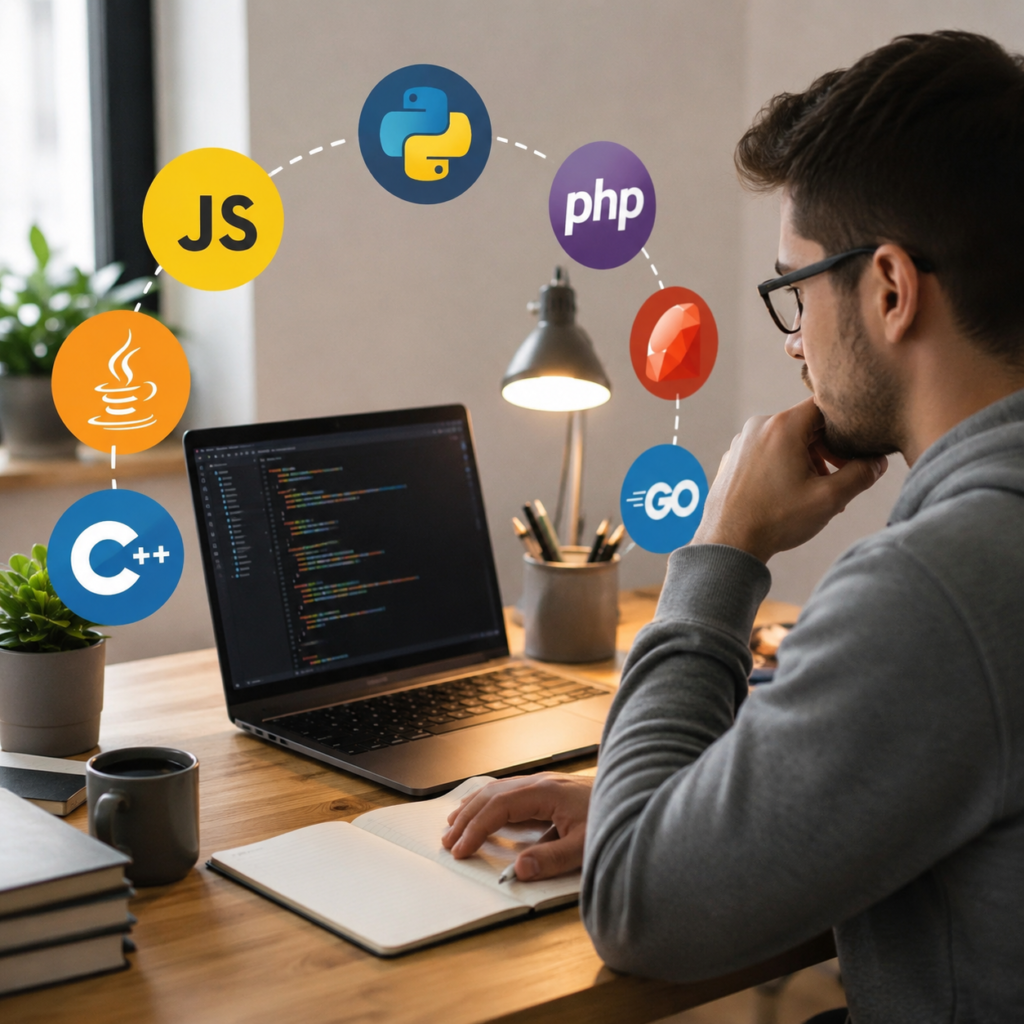
7 Beginner-Friendly Programming Languages That Helped Me Start Coding Faster
I spent two years jumping between tutorials, YouTube rabbit holes, and forum arguments about which language was “the best.” Here’s what nobody told me: the best language is the one that makes you feel like you’re actually building something by Friday night.
When I first started coding, I made the same mistake almost everyone does. I opened a browser tab and typed “best programming language to learn.” Three hours later I had 14 tabs open, zero code written, and a mild existential crisis about whether I should be learning Rust or Go. Both looked terrifying.
Eventually, a mentor told me something that changed everything: “Pick the one where the feedback loop is fastest.” Meaning, the one where you write a line, run it, and see something happen. That advice alone would have saved me months.
Below are 7 languages I’ve either started with, taught to others, or watched beginners pick up with surprising speed. Each one comes with what I wish someone had told me before I started.
1. Python: the one that actually feels like a conversation
Best for: Automation, Data, AII know, I know. Everyone says Python. But there’s a reason it keeps showing up on every “learn to code” list. It reads almost like English, which means when something breaks, you usually understand the error message. That’s not a small thing.
The first time I wrote a script that automatically renamed 200 files in a folder, I felt genuinely powerful. That’s what Python does early. It gives you wins before you’ve earned them.
import os

folder = "my_downloads"
for i, filename in enumerate(os.listdir(folder)):
    old = os.path.join(folder, filename)
    new = os.path.join(folder, f"file_{i+1}.txt")
    os.rename(old, new)
That’s it. That’s a real, useful script in 5 lines. No boilerplate, no semicolons, no confusion.
2. JavaScript: the one that lives where you already are
Best for: Web, Interactivity, Full-StackJavaScript runs in every browser on the planet. That means your development environment is already installed. Open a browser, press F12, and you have a live code editor. No setup. No installers. No Stack Overflow thread just to get started.
The downside is that JavaScript can be a bit chaotic. But for beginners, chaos later beats confusion now.
const button = document.querySelector("#myButton");
button.addEventListener("click", () => {
  document.body.style.background = "salmon";
});
You click a button. The page changes color. That feedback is instant, visual, and addictive. It keeps you coding.
3. Scratch: (yes, Scratch) the one that sounds childish but isn’t
Best for: Absolute beginners, Logic-buildingBefore you close this tab: hear me out. Scratch, made by MIT, is a visual block-based language designed for kids. I’ve also watched adults who “can’t code” build a working game in it within 90 minutes. The reason it works is simple. It removes syntax entirely. You learn the logic of programming without fighting the grammar of it.
If you’ve ever felt that your brain freezes the moment you see a colon or a curly brace, Scratch breaks that mental block. Once you understand loops and conditionals visually, they translate to every language faster than you’d expect.
4. HTML/CSS: the one nobody counts but everybody uses
Best for: Web fundamentals, Design, Portfolio buildingTechnically, HTML is a markup language and CSS is a stylesheet language. But tell that to someone who just made their first webpage look exactly the way they imagined it. The distinction stops mattering fast.
The reason I recommend HTML/CSS as an entry point is because the output is visual and immediate. You change a color, refresh the page, and the color changed. That cause-and-effect loop builds the debugging mindset that every programmer needs.
<h1 style="color: steelblue; font-family: Georgia;">
  Hello, I built this.
</h1>
Not revolutionary. But when you see that heading render in your browser for the first time, something clicks.
5. Ruby: the one designed for programmer happiness
Best for: Web apps, Rapid prototypingRuby was designed with one explicit philosophy: developer happiness. Its creator, Yukihiro Matsumoto, wanted a language that was enjoyable to write. That shows. Ruby code is expressive in a way that few languages match.
5.times { puts "This is Ruby being delightful" }
That’s a loop. One line. And it reads almost like a sentence. Ruby on Rails, its web framework, also gave the world an early model for “convention over configuration,” which drastically reduces the number of decisions beginners have to make before building something real.
6. Swift: the one that puts an app in your pocket
Best for: iOS apps, Apple ecosystemIf your goal is to build something that lives on a phone, Swift is worth the initial learning curve. Apple designed it to be safer and more readable than its predecessor Objective-C, and the Xcode playground environment lets you write code and see the results live, without running a full build every time.
The motivator here is personal. There’s something deeply satisfying about writing code and then holding the result in your hand. A lot of beginners stay motivated specifically because the output is tangible.
let languages = ["Swift", "Python", "Ruby"]
for lang in languages {
    print("Learning \(lang) is worth it.")
}
7. SQL: the one that’s secretly everywhere
Best for: Data, Business, Analyst rolesSQL is not flashy. It has no framework ecosystem, no viral frameworks, and nobody writes blog posts about its beautiful syntax. But SQL is quietly powering almost every application you use, and knowing it opens doors that other languages don’t.
What makes SQL beginner-friendly is that it’s declarative. You say what you want, not how to get it. That’s a different mental model from most languages, and for a lot of people, it clicks faster than imperative code.
SELECT name, score
FROM students
WHERE score > 85
ORDER BY score DESC;
That query is almost English. And you can run it against a real database within your first hour. Tools like DB Fiddle or SQLiteOnline let you start with zero installation.
The mistake I made early was treating “which language” as a permanent decision. It isn’t. Every experienced developer I know works in at least two or three. Your first language is not your last language, it’s just the one that teaches you how to think like a programmer.
Pick the one where the feedback loop is shortest. Write something small. Then write something slightly less small. The language matters far less than the habit of writing code every day.
If you found this useful, the best thing you can do is go open a new file and write your first line. The second-best thing is to share this with someone who keeps saying they want to learn to code but can’t figure out where to start. Drop any questions in the comments.